
Former USPS Worker gets backpay, files additional suits against postal service & McAllen police
Common struggle with fellow coworkers, not individual sacrifice or martyrdom, is the way to advance our class-interests.

Author’s Note: This article originally stated that Chris Neuens was suing the U.S. Postal Service for $500 billion dollars. In fact, he is suing them for $5 billion.
One of the many benefits and opportunities I’ve had since launching my run for Mayor of Edinburg is meeting other working-class people on the campaign trail who’ve also been fighting their own struggles against the boss-class and their government. One of these workers is Chris Shankar-Neuens, a fast-food worker in Edinburg. While we’ve many ideas in common, the way we tactically go about things in advancing our class-interests, is an important question for us to discuss.
The 39-year-old was born in India, but adopted at a very young age to an Anglo family in Wisconsin, where he was raised. His wife and kids relocated down to the Rio Grande Valley from there, in 2010, after Googling which city had both a low cost-of-living and a growing economic sector.
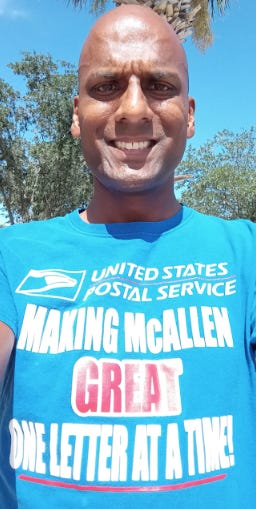
Back in Wisconsin, he worked union jobs at factories, and hoped for the same down here in Hidalgo County. His goal was to work at the U.S. Post Office.
He sent in dozens of applications over the course of years. But he didn’t get a call back until he filed for disability for anxiety in 2020. He believes his then-new disability status prompted the U.S. Postal Service to finally call him back, to meet quotas for disability hires.
He started in April 2021 and made it past the initial 90-day probationary period as well as a one year review. But after about a year and two months, he was fired for arriving to work too early, after he’d been repeatedly told to stop by management.
The post office claimed in their termination letter against Neuens that his union leadership also told him to do cease, though he denies this.
He would arrive early because he walked to work from his home and wished to discuss workplace concerns with colleagues before clocking-in. This, I realized after speaking with him, also avoided him having to walk to work at night time when it’s more dangerous.
We’ve all heard of being fired for arriving late. Neuens was fired for arriving too early, as cited in his termination letter.
Neuens believed he was only engaging in protected union activity. (A few different unions represent the different kinds of workers within the post office—clerks, drivers, etc.) During his year at USPS, Neuens was proactive in speaking to coworkers about union issues and filing safety concerns through proper channels.
He was met with apathy, disrespect, and negligence for his concerns. His fellow coworkers were resigned to “just the way things are,” and his superiors both in his union and in management were generally dismissive, he explained in an interview with me last month.
In what turned out to be his last few months working at the Post Office, Neuens had a few encounters with McAllen Police. He summoned them in April 2024 because he felt he was being detained against his will in an office room.
He had been called in for an “investigative interview”. According to the report, he told police he knew of the supervisor having a “violent history,” and asked to leave.
He was told by the supervisor that if he left the interview, he would be terminated. Neuens requested of the officer that the incident be documented.
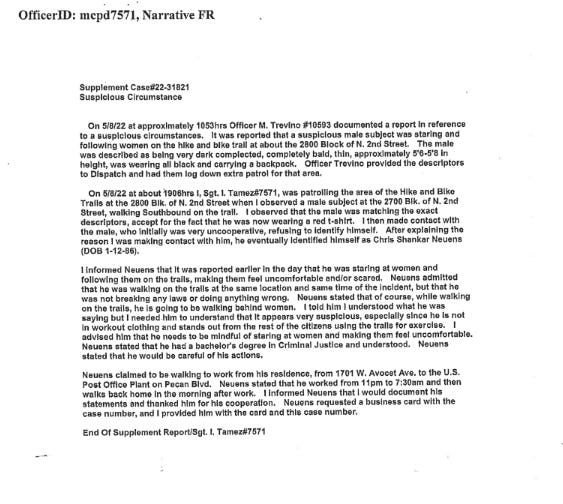
While walking to work, using the McAllen bike trails 8 May 2025, he was stopped by McAllen police officer Sergeant Isaack Tamez at around 7 p.m. Tamez informed Neuens that he matched the description regarding an individual noted in a “suspicious incident” report earlier that day in the morning, at around the time he was walking back home from work.
Claims were made that a “very dark complected male” had been staring and following women on the McAllen bike trails that morning. The officer wrote down that Neuens admitted to walking in the area at around that time, but maintained he had not done anything wrong, the report reads.
Neuens says Tamez grabbed him by the shoulder, when initially making contact.
Neuens said the officer claimed he needed to do that because he failed to stop for his siren. The officer had pulled over into one of the streets feeding in-and-out of the McAllen Hike & Bike Trails, along 2nd Street.
Neuens also says the sergeant called for back-up and frisked him on the trail. No mention of this type of search was mentioned in the report by Tamez.
Neuens was also pulled over May 7, 2024, just one day before the above incident, but says he was told by the police department that no report was ever written. He says that on his way to work, he was pulled over on the side of the road for “safety reasons.” Neuens says the officer who pulled him over accused him of being drunk, in short order.
McAllen PD, as Neuens often points out, do not wear body cams unlike most police departments. So, no up-close records of this encounter exist. The former mail worker, however, says his requests for radio traffic communications and vehicle dash-cam footage have been flouted and rejected.
Meanwhile, Neuens was getting written up at work for arriving too early, while being off-the-clock. Again, he was arriving a couple hours early before his 11 p.m. shift began, using that time to discuss union issues with coworkers.
At one point, he even attempted to run as union representative for his branch within the National Postal Mail Handlers Union. He was reprimanded for posting information on the union bulletin board in the breakroom. Postal bosses alleged it violated the agreement with the union, a claim Neuens contends.
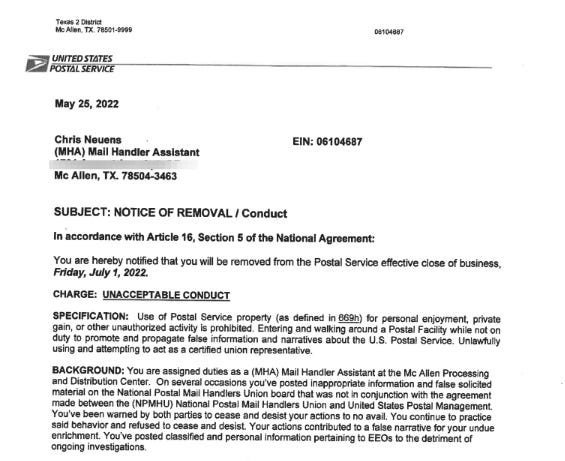
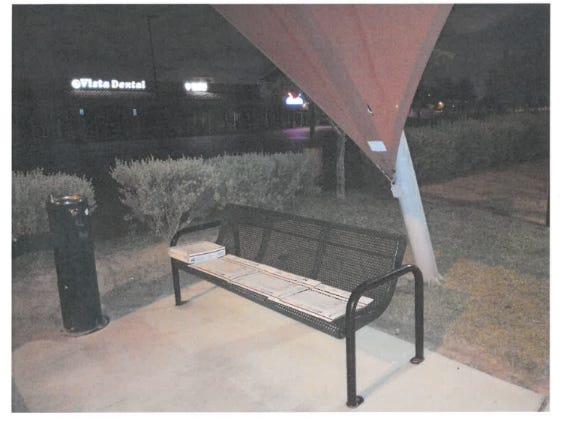
His firing ultimately came 25 May 2022 with a “notice of removal” letter. He was to stop working effective July 1. In his termination letter, the post office also alleged he was slandering the company. Not long after being fired, Neuens was made homeless, sleeping on benches along public sidewalks for two years.
Neuens’ National Labor Relations Board wrongful termination claim was finally heard in December 2024, more than two years after being fired. Because it occurred during the pandemic, officials had an excuse to delay hearings which according to its website says should only take approximately 6-8 weeks to book.
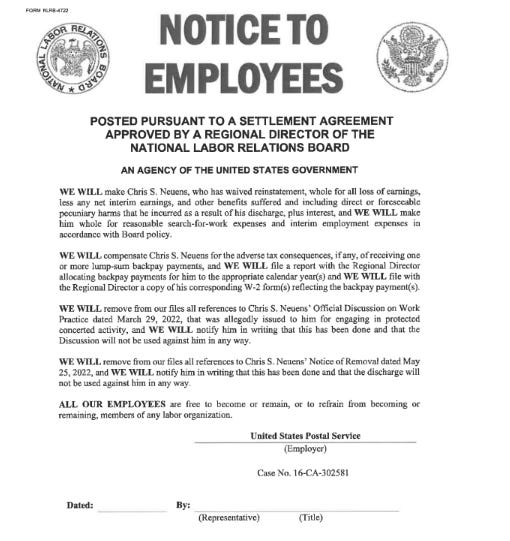
The postal service agreed to give him two years of backpay, and “expungement of discharge,” as long as he waived his right to work reinstatement. Neuens says he agreed to this because he was homeless and really struggling. He believes the Post Office understood that his plight would make him more malleable to settlement.
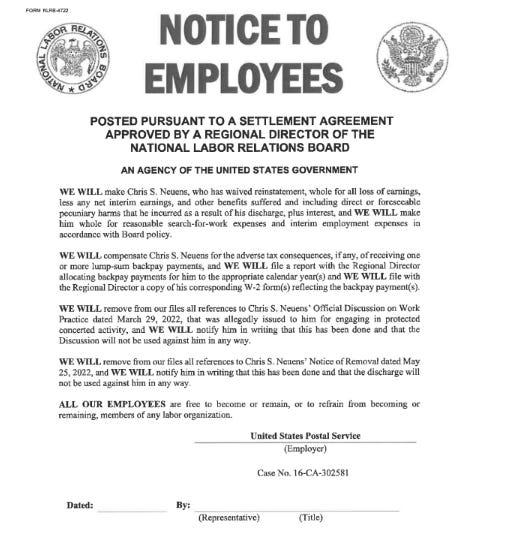
Neuens was also approached by Edinburg Police for sleeping on a bench outside the Edinburg post office when he was homeless. He notes they wore body cams, in contrast to McAllen. No altercations occurred. They offered him water.
Getting Back on His Feet
Today Neuens is off the streets and is working on a slew of lawsuits against the City of McAllen and the police department, as well as USPS for wrongful termination. Against McAllen he’s making civil rights claims. Against USPS, he’s suing for $5 billion.
The latter case was dismissed by federal judge, Randy Crane, although he later recused himself from it. Neuens appealed to the fifth circuit where the dismissal was upheld. Now he wants to take it to the Supreme Court.
He’s also filed a number of judicial misconduct complaints against Crane, alleging corruption with the City of McAllen.
Neuens originally filed suit against McAllen PD in 2024, but was not told until a year later by Judge Tipton (sitting-in for the self-recused Crane) that he could not sue a police department. He needed to sue the city. So, he refiled in July 2025, this time naming the City of McAllen as plaintiff.
The city filed a response 8 August 2025 according to Neuens requesting he rewrite his complaint in a different format, which he submitted October 6.
During this time, Neuens also made appeals to federal government figures like the state and federal attorneys general, speaker of the house Michael Johnson alongside local officials like McAllen Mayor Javier Villalobos among many others.
Neuens urged them all to address the issues related to his case.
The Way Forward for RGV Workers
Although Neuens has shown a fighting spirit in attempting to discuss workplace concerns with coworkers, exercising his right to file for back-pay among a panoply of filings and reports on which he is representing himself in court, his case is also a lesson in how going at things alone can lead to homelessness and unemployment.
Calling on the capitalist rulers’ police for help against an employer, lobbying and appealing to the officials of a capitalist government, is also not the way we’ve advanced our rights and class-interests throughout history. This only happens when working-people organize with our fellow coworkers and fellow union members in joint-action, whether it be to organize a union-drive, or to whip our existing unions into shape to stick up for us. Workers taking things on as individuals makes it too easy for the employers to target the “trouble-maker(s)” and “make examples” out of us, which is what happened here.
I myself have fallen into this error of being the voice to “speak up” before the necessary support-structures had been built over time, leading to me being targeted and victimized by managers and their snitches, something I’m sure other workers reading this have no doubt experienced at least once or thrice. But this is why these discussions are essential, so that we can learn from each other, and maintain as well as buildup a common class-consciousness and memory.
Neuens expressed support for my campaign’s willingness to talk about issues working-people face. My campaign encourages workers like himself and myself to prefer working in tandem with our coworkers, in a disciplined and organized fashion, rather than trying to use the rulers’ court system against them. Our guiding principle should always be to do that which builds our capacities as workers, to unite in common-struggle against the bosses and their government.
Like Canadian postal workers standing up to the government’s attempts to gut jobs, wages, and postal services. Workers everywhere face the same basic fight, to defend our right to organize, and strike.
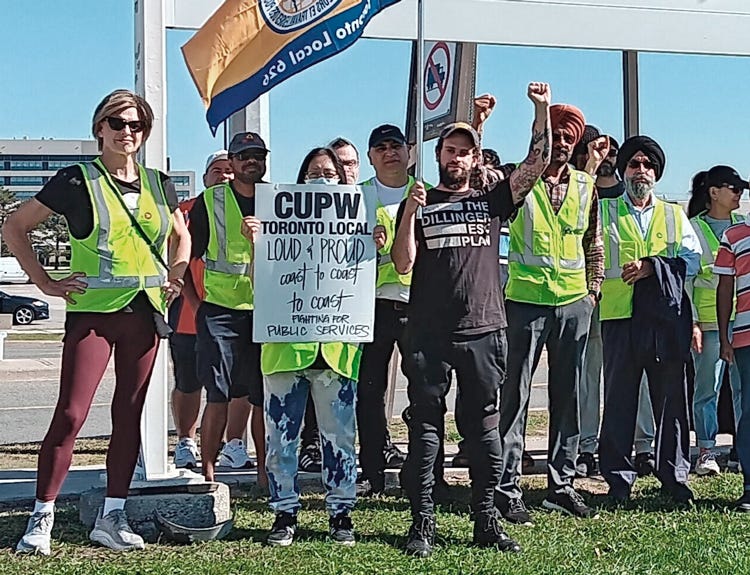
Members of the Canadian Union of Postal Workers have mounted a nationwide strike after Ottawa ordered deep cuts to mail delivery, rural post offices and benefits, while imposing “back-to-work” orders and compulsory arbitration to break workers’ resistance.
Despite these attacks, postal workers have twice rejected concessionary contracts and won solidarity from other unions, Indigenous leaders, and working people across the country who depend on public mail service. Their struggle shows that when workers act together in defense of our livelihoods, and dignity, we can inspire others and push back against the bosses’ attempts to divide and weaken us. Together, we are stronger.
This is what my campaign is all about—expressing to working-people the need for a Valley-wide movement of workers willing to fight to unionize our workplaces, strengthen our unions, and take political power.